death, dying, and the toll it takes on my mind.
published on march 12th, 2026
TW: Discussions about SA, suicide, death, + images of the dead. The images included are not gore but of preserved remains.
To an extent, every living thing is scared of death. It's a survival instinct. However, thanatophobia is uniquely human. Us humans are the only known species that is aware of our mortality and able to ponder it. Thanatophobia, also known as death anxiety, is an obsessive fear of one's own death. A sufferer can fear the pain that may come with the dying process or what lies beyond. I have thanatophobia, and I deeply fear the latter. To face the sudden onset of this fear, I dove deep into all things death-related many years ago. I want to collect all of these thoughts and ideas I have about death, and I want to put into one place which is here.
how i developed the fear
I have had severe anxiety for as long as I've known. Being a young girl at the time meant that I was "just shy," and that it was "normal." Not sure what about not eating for a week before a class presentation was "normal," but oh well. I grew up seeing my parents address my brothers' mental health issues because they were boys so of course their mental health was more important and actually real unlike mine. I don't resent my brothers for that. I am really happy that my parents are willing to help them with their issues because I worry about those two almost too much. I resent my parents for it because now I am an adult having to pick up the things they neglected to take care of their child. I could have had signs of cancer, and they probably wouldn't take me to a doctor until I was on death's door.
The refusal to actually care about my wellbeing laid the groundwork for me to develop my severe health anxiety. I grew up knowing that they would do nothing for me until it was too late. I had to beg my own mother to get me medication for pinworms. She was fully willing to let me suffer with them. I had them long enough to have a flat stomach for one of the two times in my life. I was so fucking hungry. I could have eaten the whole house and still lose weight. With female anatomy, they can also destroy you and make you infertile. I had ringworm once too, and I had to turn to DIY treatments for it. I was losing hair because I was so stressed about it. Okay, no more talk of infections. I was treated as if I was crazy when I had something wrong with me. If I was sick, I was "faking it" which meant that I had to do chores to be able to come home from school. Everyone talks about Catholic guilt, but man the work-until-you-die Protestant shit also sucks.
I was a teen that knew that anything wrong I had wouldn't be addressed. This meant that every little thing I felt could kill me. At least, that's what my brain told me. Pinch in my leg means blood clot. Slight headache means aneurysm. The taste of metal in the back of my throat means varices rupture, but of course, I forgot that I took an iron pill. I don't even know how many cancers I thought I had.
When I fear something, I am grossly interested in it. I feared many medical conditions and emergencies, so I learned a lot about them. This did not help at all. The anxious brain is a powerful thing when it knows what scares you most. As I got older, my anxious brain took in all of this information, and it was able to replicate symptoms. I'd spend weeks obsessing over the fake symptoms. This only made my parents believe me less. I was told that I was being dramatic or to get over myself. On occasion, it would be met with actual physical injury from my mother. I don't like wooden spoons.
I barely talk to my parents outside of the holidays and occasional fishing because of this. If they didn't want to actually take care of me, they don't get the privilege to know me as an adult, go to my wedding (if I have it), or see my infant (if I have one).
Fast forward to me at 22. I am in college and happily living with my current partner in our first apartment. Life is good. I've mostly healed from an on and off three year relationship that was more of a constant martial rape, but without the whole marriage thing. This person would test me by walking into traffic to see if I would grab them. I'd get random images of pools of his blood. At times, I had forgotten all of this it even happened. It was my first relationship, and I was in my second at this time. A few lost loves in between the two but nothing official.
I am alone in the apartment while my partner works a closing shift. I am browsing instagram while procrastinating on my art school homework. I still follow several people from my high school, and I check their story posts. My first partner, and second rapist, appeared with a caption that said something like, "You will be missed." My heart rate rose rapidly. I dug further only finding more posts from grieving mutual friends of ours. These mutual friends I had lost when we separated because he was more popular than I was. Someone who treated me so terribly being so loved by people who knew nothing of what happened. I lost feeling in the tips of my fingers. Then, my arms. Then, the rest of my body. Someone close to my age that I thought I loved had died by their own hands. I can't explain how or why this is the time it clicked for me, but it was. I am fucking mortal. I will die someday. I have no idea what that will be like. Holy fuck that's the scariest thing ever.
I am on the floor of my living room hitting my hands on things to feel them again. It hurt, but they still tingled. I can't breathe. My heart is beating out of my chest. I almost faint. This all happened within a minute. I realize pretty quickly that this is a panic attack and would be the first of many. I had had anxiety attacks during the covid lockdowns, but I had never experienced a panic attack. In my panic, I start doing yoga desperate to calm myself down. Yoga being the first thing I did in my first panic attack is really funny, but looking back, it was really productive and indicative of how I would approach all of this. My entirely untreated anxiety and health anxiety led to this moment. Health anxiety develops into death anxiety if left untreated. It happened to me.
This happened after two deaths in my family. My family is pretty young. My mom had me when she was only 18, so I don't see deaths in my family. I went to the funerals of a great uncle and my great grandfather whose tackle box I had somehow gotten. I was dealing with a lot of death within a month. To cope, I researched everything about death just like how I researched diseases and conditions. This brought me down many rabbit holes, and I have become pretty passionate about the subjects. I don't think it healed me. It certainly did not help with the panic attacks. For three years, I had panic attacks daily. I attended my college classes with buckled knees, sweat on my brow, and eyes bugging out. It was terrible. Slowly, I learned how my habits could influence the frequency of these things. Caffeine, diet, sleep, etc. I made sure I slept eight hours every night. This was hard at my late night job. I worked on New Years of 2024, and I didn't go to bed until 4am. I wanted to be up at 8am so I could have a fresh, full day. My heat didn't work so my hands were numb from the cold. This was a common trigger for my panic attacks at the time. Any sort of hand numbness sends me off to this day still. My cold fingers triggered the first panic attack of 2024. It would take a month and a half to recover from this. All I could think about was death.
I panicked so hard it send me into complete derealization for that month and a half. It felt like that weird blank fuzzy feeling you have when you're sick. The world was not real. I was about another week of derealization away from fully believing that the world was a simulation. During this entire period, I would end up in my usual places not knowing how or when I got there. My body was on autopilot. I was dealing with phagophobia and agoraphobia during this time too. I felt nothing and wanted nothing. My brain decided it wanted to feel what it was like to recover from deliriants. To this day, I am actually not scared of deliriants at all because I have already experienced the worst that they could be without death except my own brain did it to me. Don't worry. I have no plans to do any, but it is mad fucked that I am far more scared of shrooms than datura. I also had little voice in my head thought that maybe I should just rip the bandaid off and face death sooner rather than later. I was good at hushing this voice though, but it was there. I don't think I have fully recovered from this. There was a clear feeling when it had mostly passed though. I felt like that horse running in the wind. It feels like that once I get over a panic attack too, but then it's quickly followed by a much needed nap. I still have some derealization these days. I have issues feeling true joy, and I am more willing to be reckless because at least it feels like something. I am mostly okay.
I am stupidly stubborn in every way. I was mad that I was having panic attacks and derealization because of the death of someone who was so evil to me, so I did everything I could to work through it. I fixed my habits, told my brain that it didn't need to protect me, and got medicated for my anxiety. Still, my thanatophobia remains. It's a daily thought. It ruins my sleep because I assume dying is like falling asleep. Everything I do has me thinking in the back of my head about whether or not it's the last time I'd do this thing. I am 26 feeling like I am running out of time to do everything I want. I get sick thinking about how I have no time to do anything. I'll never see blank or do blank or experience blank. I could achieve the things I want, but still ponder death. It ruins my experiences.
death positivity
Death Positivity was something I looked to that I thought would help me. On the surface, it hasn't, but I think deep down it has helped a bit. I am passionate about Death Positivity to this day. It's the idea that the American approach to death as a subject is harmful. It comes from looking at other cultures and their treatment of death in their daily lives. Many cultures don't fear death nearly as much as Americans do. I have theories on how this come to be which I will get into later when I talk about the history of death care in the US. The fear of death in the US is so deep that people fear dead bodies themselves.
Basic things discussed in Death Positivity are:
▪ Being diligent about advance directives (wills, POA, life insurance, funeral plans, etc.)
▪ Death with Dignity which is the right to die with medical assistance to avoid dying a painful death. Can be used poorly, but if done properly and only available to those with terminal illnesses, it's a vital resource. Unfairly called "assisted suicide." It's extremely important to point out that the one choosing to die is and must be in control of the entire process even enacting the final steps. If they physically cannot do it, they will not die until their illness takes them. They can back out at any time.
▪ Being open to discuss the topic of death especially in ways to reduce fear and anxiety. It should not be a taboo subject.
▪ The Good Death which is the idea that the wishes of the dying and deceased much be respected. This covers palliative care, funeral plans, and disposal plans. Ensuring you die comfortably, your advance directive is followed, and everything you want in your death is how you wanted it to be. I deeply believe it is the job of the spouse to ensure the Good Death of their lover. In my eyes, spouses that skew wills to their benefit and don't follow their spouse's death wishes are the sickest people and belong with predators and fascists.
▪ Access to alternative death care. Death care refers to the care of the deceased. This is funerals, burials, etc. American law limits death care options which only benefits funeral and chemical companies. I'll talk about your options and what your options could be in another section.
around the world
In Japan, the family of the deceased witness the body enter the cremation chamber. They come back after the cremation is complete to pick the bones using long chopsticks to ensure that the remains remain upright in the urn. They participate in Bunkotsu which is the distribution of the remains. For those that don't know, American law requires the crematorium to grind up any remnants after a cremation before the ashes are given to the family. No evidence that it was a person can remain which I find deeply unfair to the deceased and the family.
The Toraja people let their deceased live with them in their house for long periods of time because the planes of life and death are not black and white to them. They feed them. They talk to them. They clean them and dress them. Their deceased person is still there. If you're an American, you may think of this as "gross" or off-putting. I will tell you later on about how you have been shaped by capitalist propaganda to believe that.
The Fore people are a group of people living in the Highlands of Papua New Guinea. You may know them from the discovery of the prion disease, Kuru, which was spread by their most important death ritual: the consumption of the deceased. The brain was left to be consumed last by women and children. This funerary cannibalism is vital for the passing of an individual. There's no American equivalent to this, but imagine not burying someone and just leaving them outside. It's kind of like that. The ritual is important for the passing of an individual's soul. The consumption by their loved ones means that the evil spirits won't be able to consume them. This makes the kuru disease extremely devastating not only in regards to its casualties, but its effects on their culture.
Even Europe has a more relaxed view on death. You can go to a McDonald's and see a human skeleton in the floor. Cathedral walls are filled with bones. This mass fear of death and dead bodies is uniquely American or American-influenced.
history of death care in America
Researching death care in white American cultures is difficult because most publications wrote about the introduction of embalming during the American Civil War. What is known about death care prior to the 1860s was that it was a community affair. Those close to the family of the deceased would care for the body by cleaning it and preparing it. A local woodworker would fashion a coffin for them. The church would provide a space to gather and mourn, and the wake was a joyous party. It was a huge communal event. I think what most don't know was that those that cared for the body were mostly women. At this time, women were the ones to care for new life and new death. This is important to remember.
The American Civil War and industrialization changed this completely. Families of soldiers wanted to see their deceased come home one last time, so chemists, men, produced methods of preservation. Barber-surgeons followed the soldiers around during the war to offer their services. They capitalized on death.
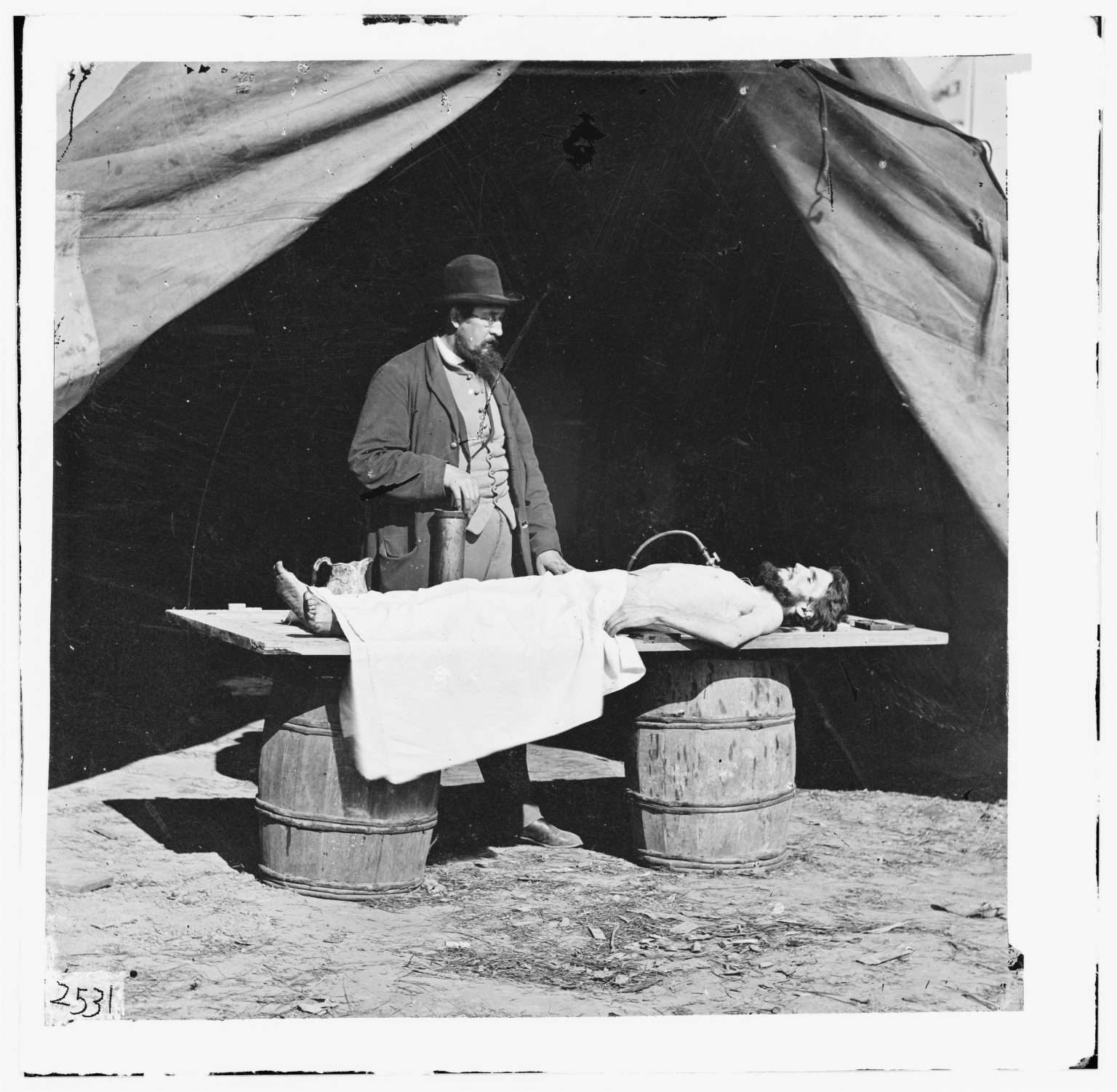
Preservation wasn't entirely new at this time as it was used to preserve anatomical specimens. Jean Gannal, a French chemist, developed a method of anatomical preservation which involved the injection of arsenic through the carotid artery. It was Thomas Holmes, "father of embalming," popularized embalming in the Civil War when he embalmed the Army Medical Corps colonel, Elmer Ellsworth. Holmes was one of many barber-surgeons that followed soldiers and used unknown soldiers as display for his work. These barber-surgeons were looked down upon and seen as predatory. It didn't stop them. Embalming took off in the US, and it remained popular after the war. Those were enslaved before the war could not gather for funerals unless they were Christian affairs. They were lively and joyful celebrations of one's life.
The fall of the Confederacy meant that these embalmers had to settle down and establish businesses. It also mean that Black Americans were no longer enslaved, but as we know, they were still discriminated even in death. Most funeral businesses at this time were owned and operated by white men. The deceased meant money to these businesses so they never turned away black families. They could arrange for the most luxurious transport even unless a white person died and that family wanted the white horse carriage. The black family would be left with mules and no money back. This led to the rise of black-owned funeral businesses. They were some of the first businesses that were owned by Black Americans. Often times, the wives of the owners would be the ones to care for the deceased and that was the first jobs for Black American women. These businesses made sure that no family was put on the back burner and that everyone got the white horse carriage treatment. To this day, Black American funerals may seem "gaudy" and "too extravagant" to White Americans. It's the reclamation of their death rights, and I think it is important to respect it even if I personally dislike the environmental impact of embalming and standard concrete vault burials. I think it's beautiful how much love they show for the deceased at these celebrations. Some of my personal favorite funeral practices come from Black American funerals such as customized caskets for children that feature their favorite characters and the Jazz Funerals of New Orleans.
Funeral homes and "outsider" help didn't become super popular until the 1900s. Men in America were able to profit on the inevitable. They became slimier and slimier with their pressure on grieving families. They lobbied for laws that would benefit them such as requiring the immediate retrieval of the deceased or hindering natural burials because it made mowing cemeteries difficult. The body would decompose and the ground would sink in. Yeah, they actually prioritized mowing the grass over the ground water, environment, and the wishes of the deceased.
These capitalist pigs successfully altered the view of death in America. They hide death from you. Dead bodies are said to make you sick, but they can only do that if they have a highly infectious disease in which case, the CDC takes them away. Viewing the dead as "gross" is incredibly demeaning to the person that they used to be. Gore content on the internet does this too. I have seen a lot of gore content, and I hate when someone flexes that they desensitized now or whatever loser shit. Its ignores the fact that the body was a person full of love, dreams, ideas, creativity, and more. They loved you, and the capitalists want you to forget all of that. They rush you into picking embalming for someone who hasn't set up their advance directive yet so you can spend a few more minutes with a "sanitized" body. They don't tell you that if the laws weren't there, you could realistically take your time with the deceased if you wanted to. If you clean and care for them, they don't decompose in the way you expect. If it was an issue, would the Toraja people do what they do? When decomposition occurs, it's done by the organisms that already live in your body. They won't hurt another person. The capitalist pigs take advantage of your grief and coerce you to sign off on things that they claim is the law when it isn't. They actually lie to you. They lobby against other options for funerary practices and disposals, and they really hate it when you host a funeral at a church or your own home. They want your fucking money.
funeral practices in the modern US
In the US, most people pick cremation or burial. You may not know that you could choose to not be embalmed if you're buried. In Judaism, embalming is viewed at unnatural because it is. Funeral homes might not let you do an open casket without embalming because they think your family would be scared. You might also drip into the casket and ruin it. Natural burials are labeled as "green burials," but you can only have green burials in particular places. Natural burials do not involve embalming, a concrete vault, and a casket. The deceased is placed into degradable clothes and wrap. Some states limit burying on your own land or they make it extremely difficult. Some people may know about the cremation to become a tree thing. No one knows that cremated remains are inorganic material and do not provide nutrients to the tree. All of these businesses depend on you being misinformed.
I am passionate about making sure people know their options. Yes, cremation and burial are the obvious ones. You can play whatever music you want at your funeral. If your death caregivers are real Gs, they will sneak in the remains of a pet into your casket. They legally cannot say that they can do that, but they will do it. The Pacific Northwest tends to be the most progressive in death care, but they're not the only ones.
You can choose to use your body as compost which can be used to help regrow parts of the environment. The idea is that you are put into a well ventilated chamber and allowed to decompose quickly. The soil created is donated to non-profits that use it to help the local environment. In Oregon, Recompose has donated soil to aid in the regrowth of tree cover over rivers where salmon spawn. This is leagues better than the tree cremation option. States where human composting is legal is Oregon, California, Colorado, New York, Vermont, and Washington. States that are in the process of legalizing it are Minnesota, Massachusetts, Delaware, and Illinois.
Aquamation, aka water cremation, is a process similar to cremation, but without the emissions. It also produces more ashes than traditional cremation. It was introduced and used in the disposal of donated medical specimens in Minnesota. It since has been legal for a long time. Aquamation is much more widespread than composting, but it still faces baseless criticism. The process involves the use of alkaline material to produce the ashes. It mimics natural decomposition, but it's much faster. It uses warm water, alkaline powder, and flow to decompose. The leftover water is beneficial for farmland. Republicans who are brainwashed by the funeral industry have claimed that aquamation is what "the cartel" does. Not only are they stupid about cartels, but they are also stupid when it comes to aquamation. The deceased is not being dissolved in acid. It's a gentle process. It's only an attempt to demonize a completely benign disposal process. Here is a list of legality of and access to aquamation broken down by states.
Death with Dignity is one of the touchier subjects that I am passionate about. Bad actors and poor regulation has had an effect on it. Death with Dignity is not euthanasia. Labelling it as "assisted suicide" is demoralizing and desensitizing as well. Death with Dignity must be done at the hand of the person choosing a comfortable death. A physician must be present during the entire process and provide the means for the patient to die comfortably. With proper regulation, it is reserved for those with terminal illnesses that end in painful, horrible deaths like ALS or forms of cancer. They must already be dying. It requires a terminal prognosis. Death with Dignity allows for the dying to say goodbye to their loved ones properly and for their loved ones to see them die in peace not pain. You may think that natural deaths are completely peaceful and calm, but you are not familiar with what hospice caregivers do. The dying has a hard time breathing because they are choking on their own spit. Sometimes, they are in pain. They can be scared too. Administering morphine is common practice for those that are near death, so that they die comfortably. In the case of terminal patients, they will be suffering in death and they would be on morphine in their last minutes. They might not be able to say goodbye. Death with Dignity allows them to be fully present with their goodbyes. It takes a very long time to reach the moment where someone has everything they need for a comfortable death. The process takes a year or more. During that time, physicians are addressing their condition(s) providing other options. Therapists and psychiatrists meet with them to make sure they are of sound mind. At every appointment, the patient is asked if they would like to continue. They can withdraw at any step even when the switch to release the chemicals is in their hand. If at any point, a professional says that they are unfit to continue, the patient is denied even if they are too weak to use the switch. No one can flick it for them. It is a difficult and tiring process to set up. To call it euthanasia or assisted suicide is deeply unfair.
People who have taken advantage of suffering individuals are a stain on the movement. Evil people like George Exoo who provided oral poisons and gave instructions over the phone. He was excited to kill people. He rushed them into it. He features in the documentary, Reverend Death, which I recommend everyone watch. He is the exact opposite of what proper Death with Dignity looks like. Online forums on the subject often fill with people providing methods of suicide which also ruins it all. Death with Dignity is for the physically ill. Not the mentally ill. Seeking legalization of Death with Dignity can limit those who seek it through death tourism.
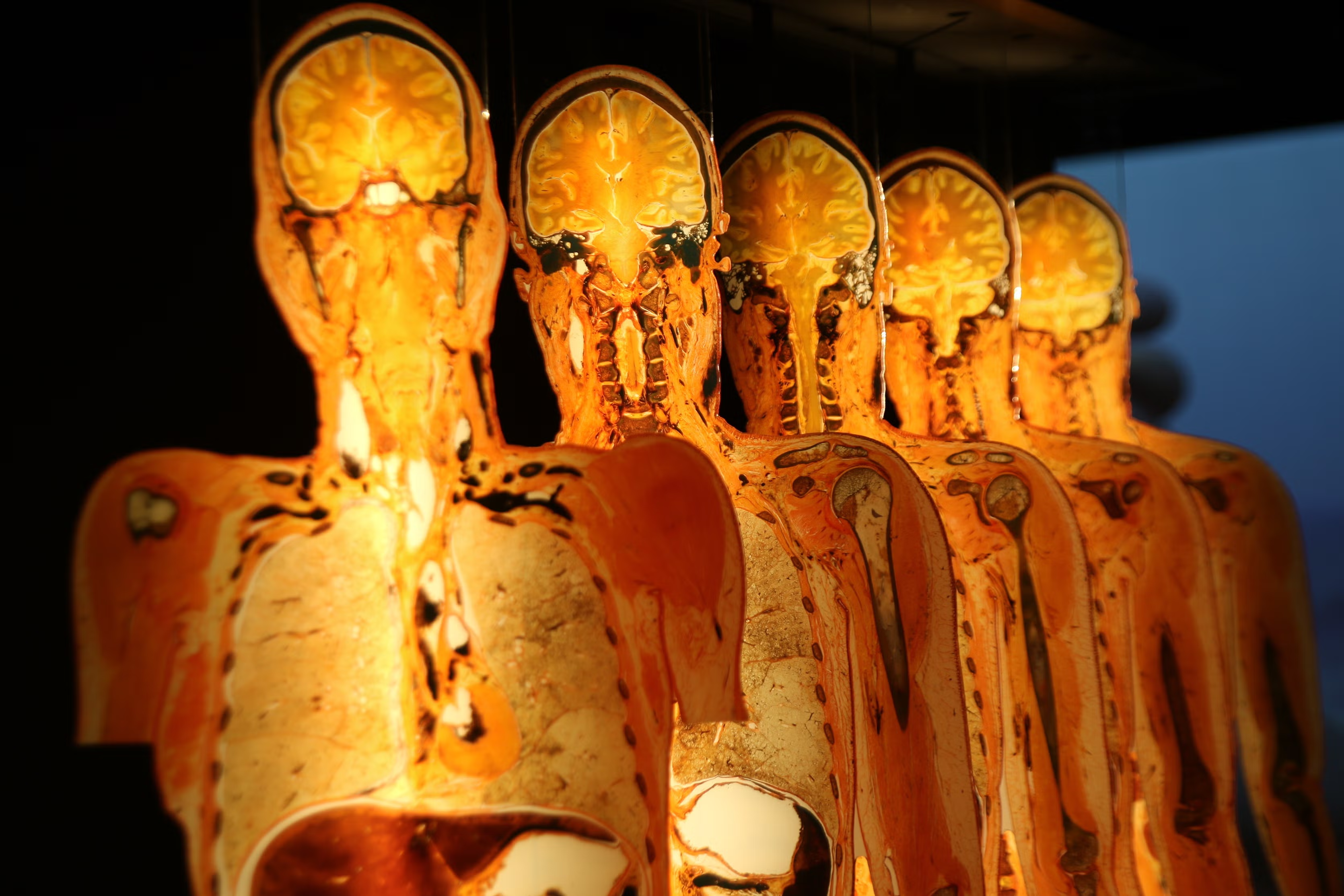
It is not uncommon for a white person to discover a funerary practice of another culture and wish to participate in it themselves. Tibetan sky burials being one of the most popular because it is seen as "badass." It's a beautiful practice, but it's not their culture. I am all for respecting someone's wishes, but understanding the incredibly deep meaning of another culture's practices is more important than participating in it yourself. To have a sky burial, you must be Tibetan. Tibet has rightfully limited this to prevent the shipment of bodies to their country. Your other option is an open air cremation, but it requires that you be a resident in the one county in Colorado that it is legal in. If you donate your body, you cannot trust body brokers to respect your wishes. Organ donation is crucial, but an overall sketchy business. "Donating to science" is vague enough where the "science" can be the military blowing you up. If you choose to donate, you have to be clear of where you'd like your body to go. You can be an anatomical specimen for students. You can be studied for forensics students. You can even be plasticized for the two traveling exhibitions that show plasticized bodies. However, I don't recommend that personally. You cannot choose how you are displayed, and you will be displayed along side Chinese political prisoners whose identities are unknown. They were cheap bodies for the German man to get. This is the case for many undocumented human remains. I don't know the name of the real human skeleton I drew in art school.
the impact this research has had on me
I think I came out of all of this as a more compassionate person. Death in the world holds a lot more significance to me than it does for many people who are desensitized to it in media (yet those same people deeply fear their own death). The emotional impact it has on me can be too much at times. I take death in media very seriously too. I find video games that depict death as a trivial thing as tasteless, but at the time same, death should be an easy subject to talk about and even joke about. It's a fine line between being disrespectful and being too sheltered. I haven't quite found the right spot for myself.
I mentioned it briefly, but I have a harder time with gore content now. I never liked it. I never sought it out, but I wasn't as deeply affected by it if it came up to shock me on the internet. I hate calling it "content" too. Videos of people dying being used as something to shock unsuspecting people is disrespectful to those suffering in those photos and videos. Those were people with lives as complex as your own. I find it gross when someone says that they've seen so much that they're desensitized. I've seen as much as them, but I at least have a heart. There is no use for gore videos and photos, and the people in them did not ask to be used to "help desensitize" people. If you want to be desensitized to death, take care of the dead and dying as a career.
On the topic of death care careers, I came out of all of this believing that only women should take care of the dead. Men took that incredible privilege away from us women to make money off of it. I don't like gender roles, but I believe in this one. Women also don't rape dead people. Men do. The ones perceived as weak are never free from the power men seek even in the death of the victim. A scumbag was buried directly on top of Marilyn Monroe facing down towards her. A woman would not have let that happen. This belief that women belong in death care isn't trans-exclusionary also. I think more trans people in the death care industry would be amazing because we need more people respecting the wishes of the dead who happen to be trans. Not that the only ones who would respect them are trans people themselves, but often times, male-operated funeral homes will refer to the deceased by their dead name and incorrect pronouns. It will end up on their headstone. That is not the Good Death, and it is disgustingly a sick act to disrespect someone like that. Trans representation in the death care industry would be a beautiful thing.
As for my own death, I still am terrified of it. I am far from spiritual or religious, so I don’t see anything beyond life. It’s the abyss. You don’t see darkness. There is nothing. You cease to exist. We cannot perceive it or imagine it which is what scares me most. It is unknown. My stomach is churning as I write this part. This belief makes me have nihilistic thoughts about life. I know I act all silly and happy, but it’s because there is nothing else to life other than that. Because I am going to die, I might as well try to have fun being alive.
For those that worry about my little suicidal voice, don’t worry. It’s incredibly quiet. If I can’t make my early death worthwhile, then I must save it for something useful. I don’t seek martyrdom in my death, but we’re in an age where you can’t run away from it. If I know my death could lead to something good, I wouldn’t regret it. It’s a waste if I go out early, and it achieves nothing. I’m more stubborn than the voice is loud.
what I hope for you
Ultimately, I hope you didn’t find this scary. My intention isn’t to frighten anyone, but to motivate them to address death in a healthy way. Death is real and everyone should openly discuss it otherwise people will just suffer from thanatophobia. Trust me, it sucks so much.
It's never too early to organize your advance directive. Doing so won't jinx your death either. Be clear with your trusted loved ones about your wishes and urge them to do the same. Understand laws about the care of the deceased based on your state or country. Advocate for more options especially more truly eco-conscious ones. Below are a number of resources with the first being suicide help. Though I believe in Death with Dignity, suicide is never the option.
resources
988 is the suicide hotline number. Click here for their site. They provide help in several languages and are able to accommodate for your needs/disabilities.
Find your state's advance directive. Healthcare providers can provide it for you too.
sources of information + images
Birth of the Funeral Profession
Evolution of American Funerary Customs and Laws
How the Civil War Reshaped American Funeral Practice
What is Aquamation? (a veterinary resource, but it applies to humans too)
Novia muerte, Chalma, México (Death Bride, Chalma, Mexico) by Graciela Iturbide
Death Stalking a Woman by Carl Gotthard Langhans
Wandering Death by Ernst Barlach